How Accuracy Is Ensured
Prodia ensures accuracy through a controlled chain that is verifiable, traceable, and continuously improved.
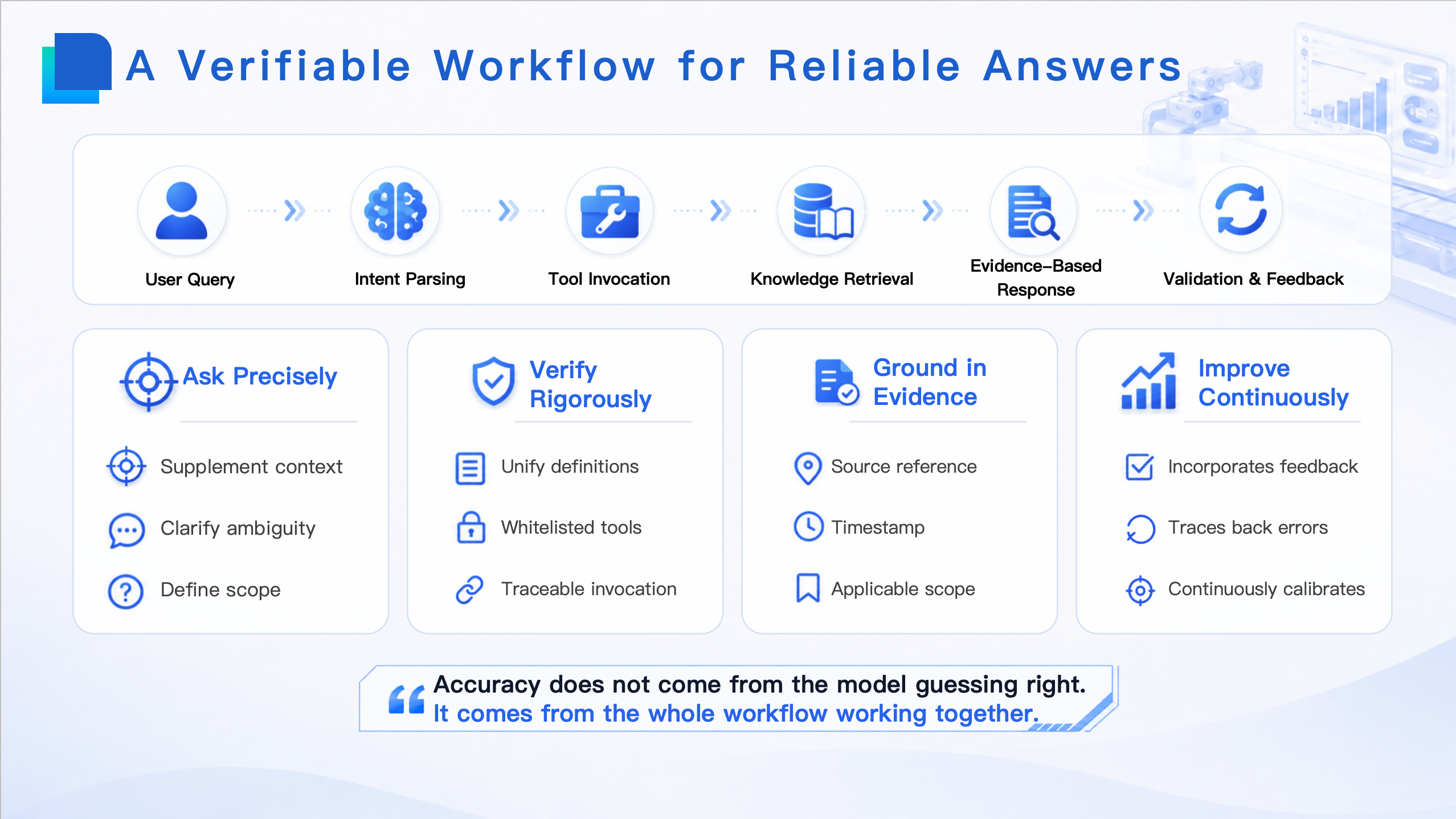
1. Accuracy comes from four things
It can be summarized as:
structured input + governed invocation + verifiable evidence + closed-loop output
This means the system first determines what the user is really trying to solve, then decides what data to retrieve, which tools to invoke, and what level of conclusion is appropriate.
2. Ask the question correctly first
User questions are often incomplete, informal, or missing context. To avoid answering the wrong thing, the system:
- recognizes intent before generating an answer
- transforms natural language into a structured problem
- fills required context such as process, equipment, time window, batch, and indicator
- clarifies or constrains ambiguous questions
- rejects or downgrades questions outside the data boundary
The core principle is:
precise questions create precise answers.
3. Plan first, then form conclusions
If the model is allowed to improvise freely, hallucination becomes much more likely. At this layer, Prodia:
- classifies the task first: query, explanation, diagnosis, or recommendation
- uses the model to understand, plan, and select tools
- forms conclusions on top of supporting evidence
- constrains output into structured fields
- breaks complex issues into smaller steps
The core principle is:
the model plans the reasoning path before producing evidence-based conclusions.
4. Governed invocation for stable analysis paths
At this layer, Prodia keeps MCP and tool calls within stable analytical boundaries:
- defines explicit schema and parameter constraints for each tool
- uses whitelists so only authorized capabilities can be invoked
- validates inputs such as time range, equipment scope, and indicator type
- favors governed query interfaces to keep analytical definitions consistent
- records what was called, why it was called, and what came back
5. Retrieve the right data for the right issue
To keep conclusions explainable and traceable, Prodia ensures the returned result matches the issue being analyzed:
- aligns equipment, process, batch, and indicator semantics before querying
- attaches source, timestamp, and applicability range to returned results
- checks consistency across sources when necessary
- returns evidence before conclusions
- version-controls knowledge content to reduce outdated guidance
- binds critical answers to grounding or citation when needed
6. Conclusions must be grounded in evidence
Even when the right data is retrieved, the model may still over-summarize or over-infer. To prevent that, Prodia:
- generates only from retrieved evidence
- distinguishes fact, judgment, and recommendation
- provides evidence together with recommended action
- adds confidence hints for critical conclusions
- explicitly says "insufficient to judge" when evidence is weak
- defaults to recommendation plus rationale in high-risk scenarios so engineers can make the final confirmation

7. Accuracy is continuously calibrated through use
Accuracy improves through repeated use and feedback. To keep getting more accurate over time, Prodia:
- records whether recommendations are adopted
- tracks whether outcomes improve after adoption
- reviews incorrect recommendations
- iterates rules, cases, and recommendation logic
- turns high-quality handling processes into reusable experience
8. A simplified way to understand it
AI accuracy comes from the full analysis and feedback chain:
asking precisely, querying correctly, grounding in evidence, validating, and feeding results back.