PadHMI
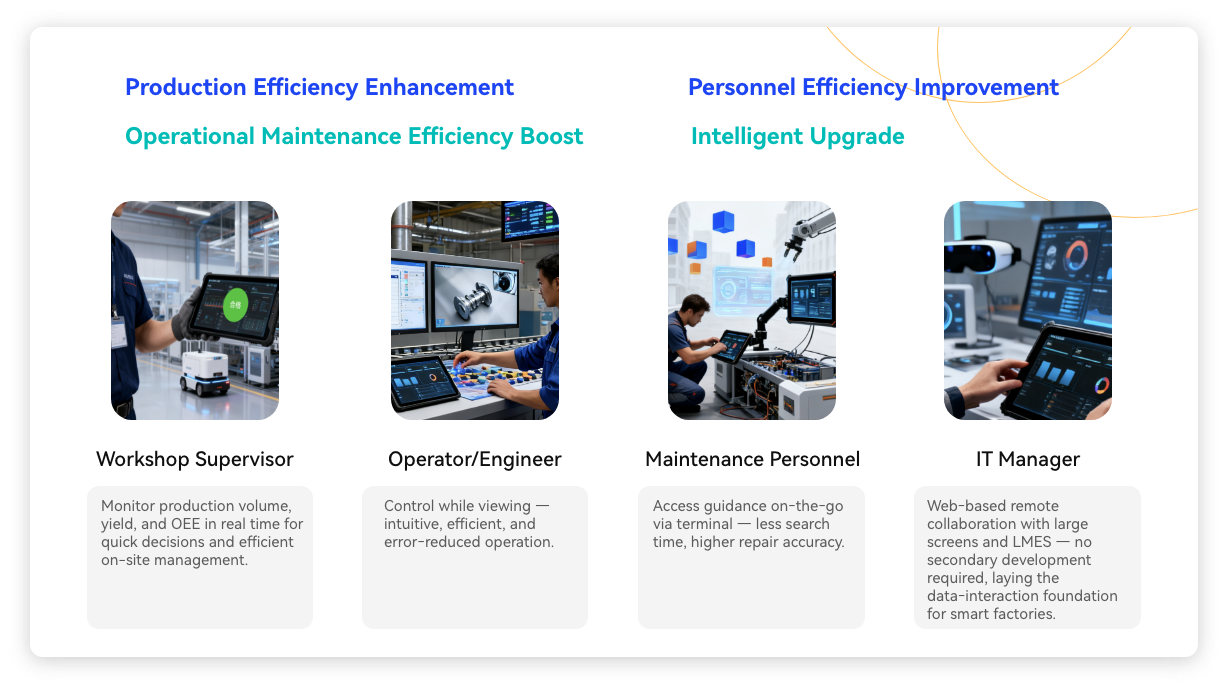
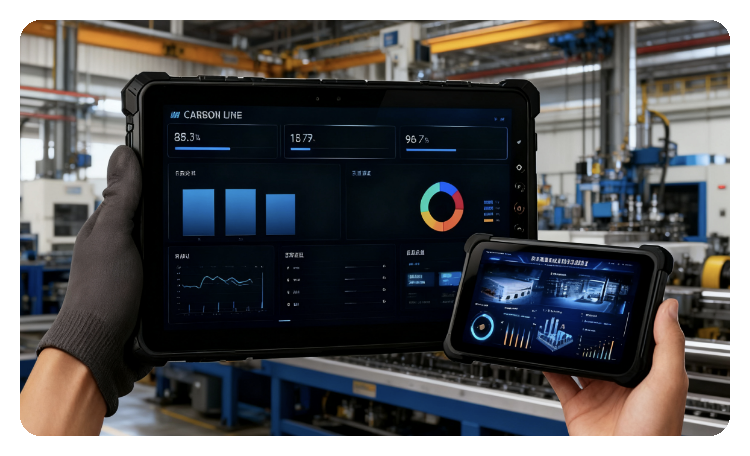
PadHMI is a portable handheld HMI intelligent terminal specifically designed for industrial environments. Supporting remote Web access, it can seamlessly collaborate with the Smart HMI/LMES, fully covering diverse industrial application scenarios such as intelligent Q&A, production monitoring, process collaboration, parameter dispatch, recipe management, patrol inspection, and maintenance guidance. The product continues the mature and stable software and hardware architecture of the Smart HMI, adopting an all-weather durable design capable of adapting to various harsh industrial environments. With PadHMI, users can easily monitor production equipment/lines and interact with information while on the move, helping enterprises build a complete business loop for production digitalization and efficiently promoting the intelligent upgrade of production management.
Product Features
Application Scenarios
Mobile Dashboard/Production Monitoring
Supervisors can view yield, defective rate, alarms, and key KPIs (such as OEE) at any time while moving around the workshop, and can remotely confirm downtime reasons or issue instructions.
AI Interactive Terminal
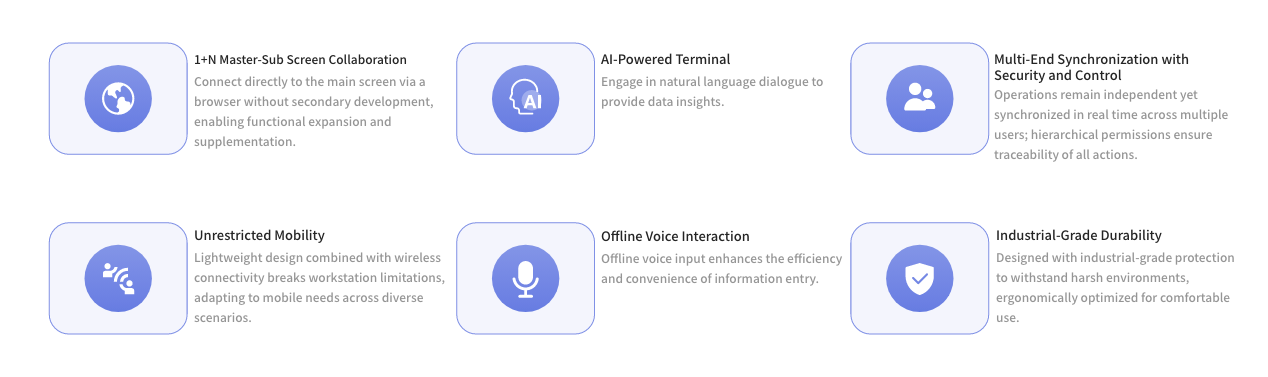
Combined with ChatBI, PadHMI interacts through natural language dialogue. Based on AI, it automatically generates chart reports, lowering the threshold for analysis and diagnosis, helping field personnel make quick decisions and solve problems efficiently.
Machine Tuning and Parameter Dispatch (On-site Debugging/Product Changeover)
Operators use PadHMI to directly view and modify process parameters, call and dispatch recipes near the equipment or at different positions on the production line, reducing walking back and forth to fixed consoles and improving changeover efficiency.
Patrol Inspection and Spot Check
Inspectors carry PadHMI to read equipment status, real-time data from vibration/temperature sensors, record work orders, and take photos for upload, generating instant patrol reports and traceability records. PadHMI supports offline voice input, making information entry simpler and more efficient.
Maintenance and Repair Guidance
Maintenance personnel carry the handheld terminal according to work orders to view guidelines, 3D disassembly steps, historical maintenance records, and solutions, and report fault causes and handling measures in real-time via voice input.
Material Picking and Tracking
In warehouse management, PadHMI replaces traditional barcode scanners. It can not only scan but also receive detailed picking tasks, location guidance, material information, and quantities from WMS. After completing the picking, operators can confirm and electronically sign on the device, and data is transmitted back to the system in real-time to update inventory status.
Material Feeding Verification
During production line feeding, operators use PadHMI to scan material barcodes/QR codes. The system automatically verifies whether the material information (model, batch, quantity) matches the production work order. Through database matching or check digit verification, it quickly checks. If the match is successful, it prompts for feeding; if not, it warns and prompts the correct information to prevent feeding errors.
Tooling Replacement Verification
Tooling replacement verification: When changing tooling, molds, or fixtures, operators use PadHMI to scan equipment codes and tooling QR codes, and verify whether the tooling fits the equipment and product model according to verification rules or interaction with the background. For example, in an automobile welding workshop, welding tongs fixtures differ for different car models. Scanning verification can avoid equipment damage or product defects caused by incorrect installation.
Mobile Work Orders and Approval Process
Complete processes such as abnormality confirmation and work order completion confirmation within the workshop through the handheld PadHMI. Persons in charge can perform electronic signatures and approvals. Approval results are automatically transmitted back to ERP, MES, and other systems to trigger subsequent processes, reducing paper document transmission and waiting, thereby improving process efficiency.
Manual Quality Inspection and AI-Assisted Inspection
Inspection personnel input inspection results, call AI judgment, or take photos to upload for cloud/local model recognition through the handheld device, inspecting and recording simultaneously to reduce rework.
Customer Value