Core Value
Manufacturing teams evaluate AI products by the speed of result improvement, the ability to scale expertise, and the visibility of ROI.
1. Customers buy outcomes, not features
What customers actually want to know is:
- can a new specification be stabilized faster after launch
- can operating fluctuation and equipment risk be identified earlier
- can dependency on a small number of experts be reduced
- can the ROI of data investment become clearer and more measurable
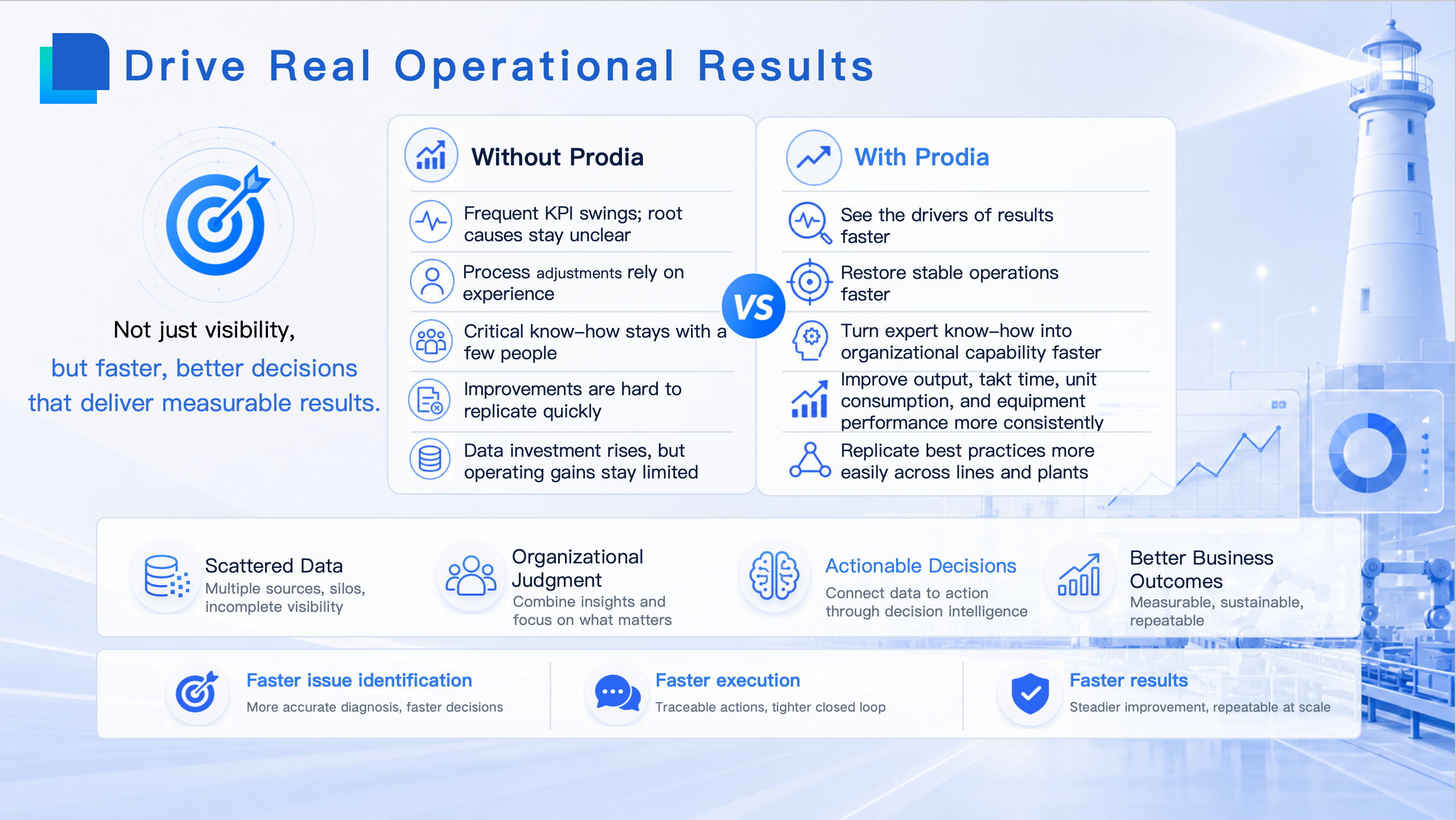
In one sentence:
Customers buy more stable production results and clearer ROI.
2. Four direct forms of value
1. Stabilize production faster
- bring new specifications, recipes, and operating conditions into a stable window faster
- reduce repeated trial tuning and low-value iteration
- pull fluctuation back into a controllable range sooner
2. Improve key indicators more steadily
- understand faster why output, takt, yield, or unit consumption changed
- identify the most important cause sooner
- make optimization action more focused and more stable in effect
3. Reduce anomaly and loss
- identify equipment anomaly trends and forward maintenance opportunities earlier
- reduce downtime, waiting, inefficient troubleshooting, and anomaly spread
- lower the cost of judgment delays caused by experience gaps
4. Increase people efficiency and reusable expertise
- turn expert know-how into organizational capability
- shorten time spent on finding data, analyzing, searching documentation, and troubleshooting
- make cross-line and cross-plant replication easier
3. Value for different roles
| Role | Traditional pain point | Value delivered by Prodia |
|---|---|---|
| Management | Indicators fluctuate, but the main driver is unclear | Faster visibility into main causes and operational priorities |
| Production supervisors | When output, takt, or unit consumption worsens, it is hard to know what to address first | Faster loss-structure understanding and optimization priorities |
| Process / quality engineers | Process tuning and quality improvement depend heavily on experience | Faster parameter guidance, process-window judgment, and improvement direction |
| Equipment engineers | Operating fluctuation and equipment risk are often recognized too late | Earlier anomaly trends, risk identification, and forward maintenance actions |
| Business leaders / operations owners | A lot has been invested in data, but business improvement is still too slow | Stronger connection between analytics and stable production, efficiency, consumption, and loss outcomes |
4. Why ROI becomes easier to explain
Prodia is usually evaluated across three ROI dimensions:
| Value dimension | Typical direction of improvement |
|---|---|
| People efficiency | Less manual reporting, manual investigation, and repeated expert involvement |
| Loss reduction | Lower downtime, scrap, rework, waiting, and low-efficiency collaboration cost |
| Business impact | Better production stability, takt stability, OEE, yield, unit consumption, and delivery performance |
This is why Prodia is often evaluated as a results project with direct business impact.
5. The real value progression
The improvement path can be summarized as:
fragmented data → organized judgment → action formation → business result improvement
The real progression is:
- stabilize production faster
- improve key indicators more steadily
- reduce anomaly and loss
- strengthen people efficiency and reusable expertise