Product Positioning
Prodia can be summarized in one sentence:
an AI reasoning and decision system that turns fragmented manufacturing data, process knowledge, and expert know-how into executable operational judgment.
Its purpose is to move an issue from signal to judgment, from judgment to action, and from action to measurable result.
1. What Prodia is
Prodia sits between “data is visible” and “results are delivered,” filling the missing layer between data, judgment, and action:
- identify the issue worth acting on now
- place process, equipment, parameters, indicators, and events into one judgment chain
- recommend action that is closer to the way the site actually works
- capture adoption and outcome for continuous improvement
2. Why the market needs it now
Manufacturing no longer struggles primarily with whether data exists. The real challenge is whether teams can turn that data into results fast enough.
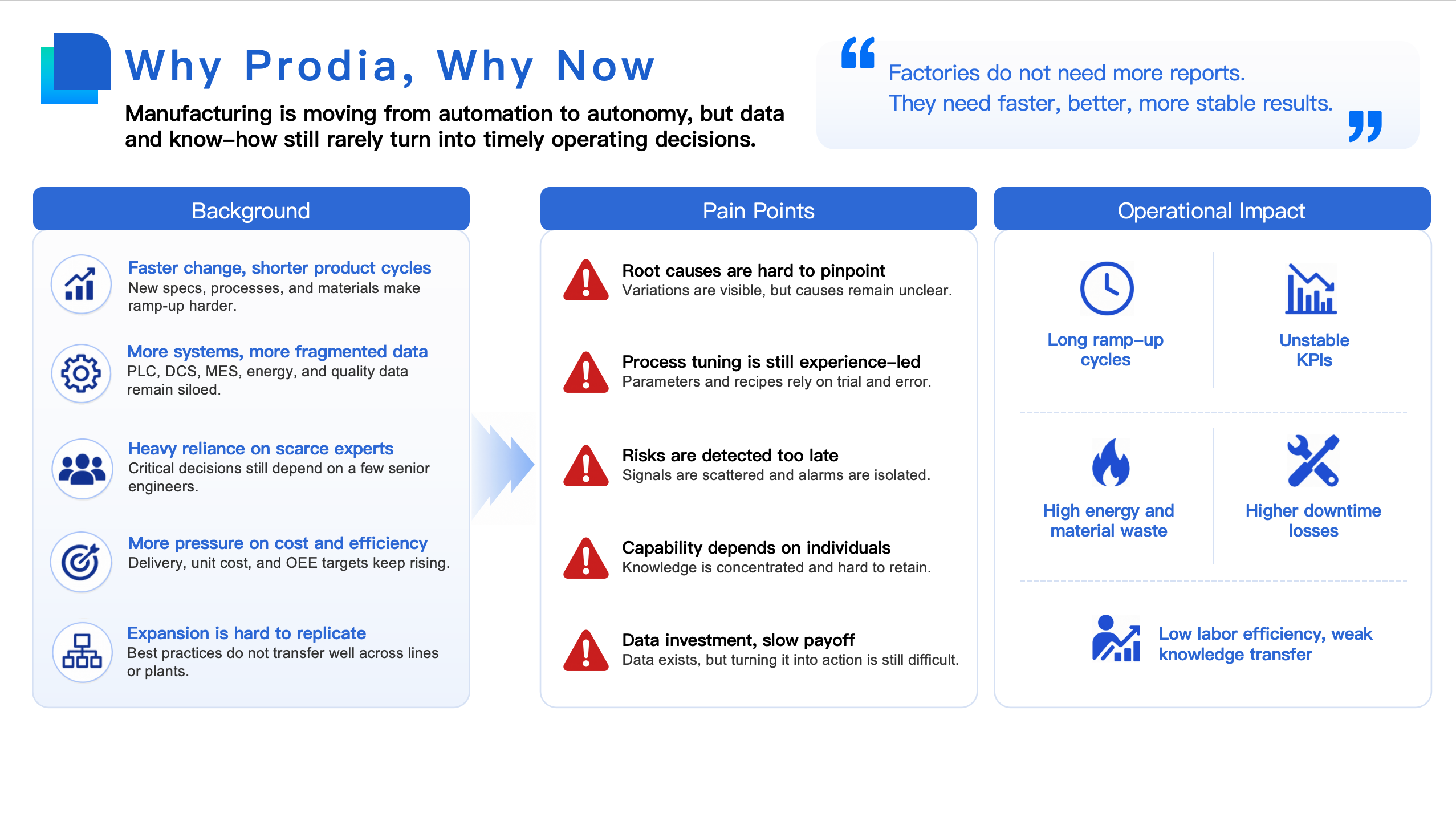
This need is driven by four realities:
- faster change: specification changes, material shifts, and process variation make manual trial tuning too slow
- more systems: PLC, DCS, MES, quality, energy, and maintenance systems all hold useful data, but the logic is fragmented
- scarcer expertise: critical judgment still depends on a small number of experienced people
- stronger result pressure: leadership cares about stable production, efficiency, consumption, loss outcomes, and measurable ROI
3. How Prodia should be understood in the factory
From a customer-value perspective, Prodia plays four roles:
- operational judgment engine: forms action-oriented judgment around process, equipment, parameters, indicators, and anomalies
- expert capability amplifier: turns the reasoning path of a few experts into reusable organizational capability
- optimization coordination hub: connects outcome, cause, priority, recommendation, and review into one loop
- business result support system: supports stable production, efficiency improvement, consumption reduction, loss reduction, and predictive maintenance
4. How it differs from general AI or traditional BI
| Dimension | General AI / traditional BI | Prodia |
|---|---|---|
| Core task | answer questions, display data | form judgment, support action |
| Problem scope | one query or one explanation at a time | combined reasoning across process, equipment, parameters, indicators, and events |
| Output | text answer, report, chart | cause judgment, priority, recommended action, supporting evidence |
| Value accumulation | answer ends when the response is delivered | adoption and outcomes are fed back for reuse |
Its differentiation comes from turning data into operational results more directly.
5. Product boundary and collaboration model
Prodia operates at the analysis and decision-support layer and collaborates with frontline engineers and execution systems:
- the system organizes data, knowledge, and rules
- the system produces cause candidates, recommendations, and evidence
- engineers decide whether to adopt and how to execute
- results return to the system for continuous improvement
This collaboration model is especially well suited for three high-value scenario groups:
- process optimization: stabilize new specifications faster, understand process windows better, and adjust parameters with more confidence
- operational efficiency optimization: understand faster why output, unit consumption, and takt are deteriorating, and which lever to optimize first
- equipment efficiency optimization: identify operating deviation and equipment risk earlier, enabling more forward-looking intervention
6. Positioning summary
Prodia is positioned to organize manufacturing issues into executable judgment and move them faster toward business results.