Product Architecture
Prodia uses a five-layer AI reasoning and decision architecture that connects the data foundation all the way to operational action.
1. Why a full product architecture is necessary
Manufacturing teams typically need four conditions to be true at the same time:
- data has already been cleaned, aligned, and made connectable
- process, equipment, batches, and indicators share unified semantics
- rules, cases, and expert know-how can enter the same judgment path
- suggested actions are evidence-based, traceable, and verifiable
The architecture exists to make these conditions hold together.
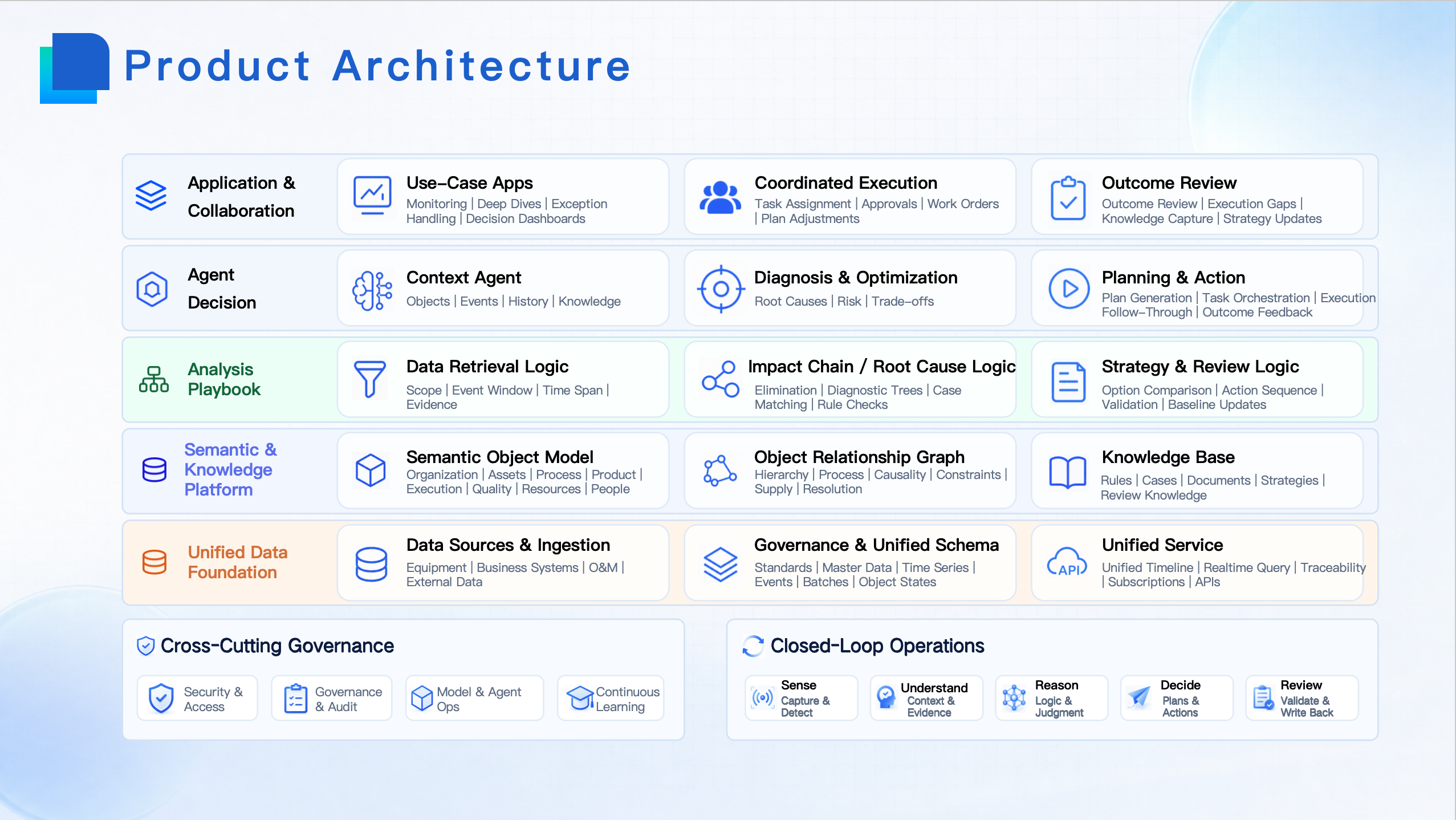
2. What each of the five layers does
| Architecture layer | Composition | Responsibility |
|---|---|---|
| Layer 1: Unified data foundation | real-time equipment data, control and process data, quality and inspection data, energy and resource data, maintenance data, business and planning data, external environment data | provide the factual foundation |
| Layer 2: Data governance and service | data acquisition, cleaning, standardized modeling, time-series alignment, event processing, multi-source association, unified query and service output | make data usable, clean, and connectable |
| Layer 3: Semantic and knowledge center | object models, relationship graphs, rule libraries, case libraries, document libraries, strategy libraries, review knowledge | make the system truly understand process, equipment, parameters, indicators, and anomalies |
| Layer 4: Analysis playbook and AI decision layer | data retrieval logic, influence chains, root-cause logic, strategy comparison, analytical models, agent reasoning, decision orchestration | organize data, knowledge, rules, and models into one reasoning path |
| Layer 5: Scenario application and collaboration | exception diagnosis, process optimization, efficiency optimization, planning coordination, recommendation output, action execution, result review | turn reasoning output into actionable operational steps |
3. What these five layers ultimately produce
The architecture ultimately delivers an operational result chain:
- identify deviation
- locate the main cause
- generate options
- support execution
- verify outcomes
- continue learning
In one sentence:
from a unified data foundation to AI reasoning and decision, Prodia turns data into actionable operational moves.
4. Three readiness conditions
Prodia’s architecture is built to make three readiness conditions true at the same time:
- data ready: data is usable, clean, and connectable
- semantic ready: process is understandable, anomalies are explainable, indicators are aligned, and actions are actionable
- decision ready: recommendations are evidence-based, verifiable, reviewable, and improvable
Together, these three readiness conditions determine whether recommendations can be accurate, actionable, and measurable:
- data ready improves analytical accuracy
- semantic ready improves operational fit
- decision ready improves measurability and follow-through
5. How the architecture supports the three core scenario groups
| Scenario group | Required supporting capability |
|---|---|
| Process optimization | process curves, parameter windows, historical successful batches, expert rules, recipe-to-result relationship |
| Operational efficiency optimization | output, takt, unit consumption, loss decomposition, main-cause identification, optimization priorities |
| Equipment efficiency optimization | alarm linkage, operating deviation, equipment state, inspection suggestions, predictive maintenance support |
Because the architecture covers both the data foundation and the judgment-to-action layer, it supports industrial AI programs with clear result ownership.