First Pilot Path
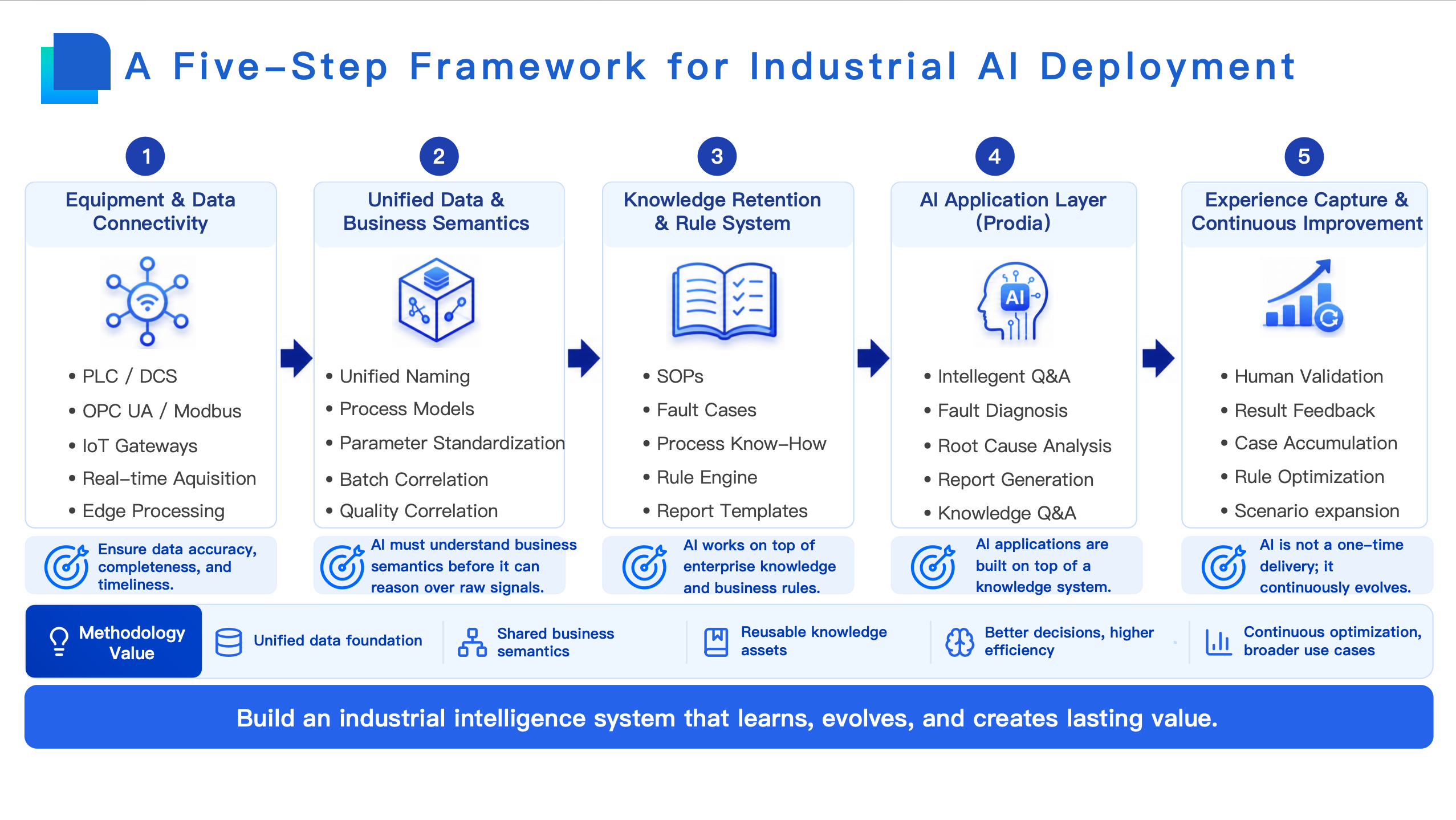
For a first pilot, Prodia works best when the team focuses on one high-value problem and runs a small loop of forming judgment -> giving recommendations -> engineer confirmation -> result recovery.
1. What the first pilot should actually prove
A first pilot usually verifies these three things first:
- whether the system can form stable judgment around one high-value issue
- whether it can produce evidence-based, actionable recommendations
- whether the site can get results faster with less dependence on experts
In other words, the goal is to prove this:
Prodia can reliably move one typical problem from "seeing an issue" to "taking action and verifying the result" on top of the current data foundation.
2. A recommended four-step pilot path
| Step | What to confirm | Typical output | Recommended reading |
|---|---|---|---|
| Step 1 Select the problem | Pick a problem with high impact, frequent review, and visible value | pilot topic, scope, target roles | Typical Scenarios / Role-based Scenarios |
| Step 2 Check the data | Confirm what objects, indicators, events, and knowledge context are currently available | minimum data checklist, capability boundary | Data Readiness and Activation Conditions / Product Architecture |
| Step 3 Run the loop | Design one real path from judgment to recommendation to execution feedback | demo questions, analysis result, suggested actions, feedback path | Feature Overview / How Prodia Collaborates with Frontline Engineers |
| Step 4 Define acceptance | Clarify what "effective" means for this pilot | acceptance criteria, review conclusions, next-phase scope | Core Value / Why Prodia Gets Stronger with Use |
3. Step 1: start with a problem worth testing
The best first pilot topics usually share a few characteristics:
- the business team genuinely cares because they directly affect quality, efficiency, unit consumption, downtime, or cost
- some usable data and knowledge foundation already exists
- the scope is concrete enough to validate whether recommendations work and whether outcomes improve
Typical starting points include:
- stabilizing a new specification faster
- attribution of output / unit consumption / takt deterioration
- early identification of critical equipment anomalies
4. Step 2: check the data foundation and define the starting scope
What Prodia can deliver depends on the combination of model capability and site readiness:
- object master data: line, process, station, equipment, product, work order, shift
- core indicators: output, yield, OEE, takt, unit consumption, faults, and similar metrics
- contextual events: alarms, downtime, state transitions, process parameters, batch changes
- operational knowledge: SOPs, cases, maintenance documents, review notes, process windows
5. Step 3: run the loop
A useful first pilot should run through this path at minimum:
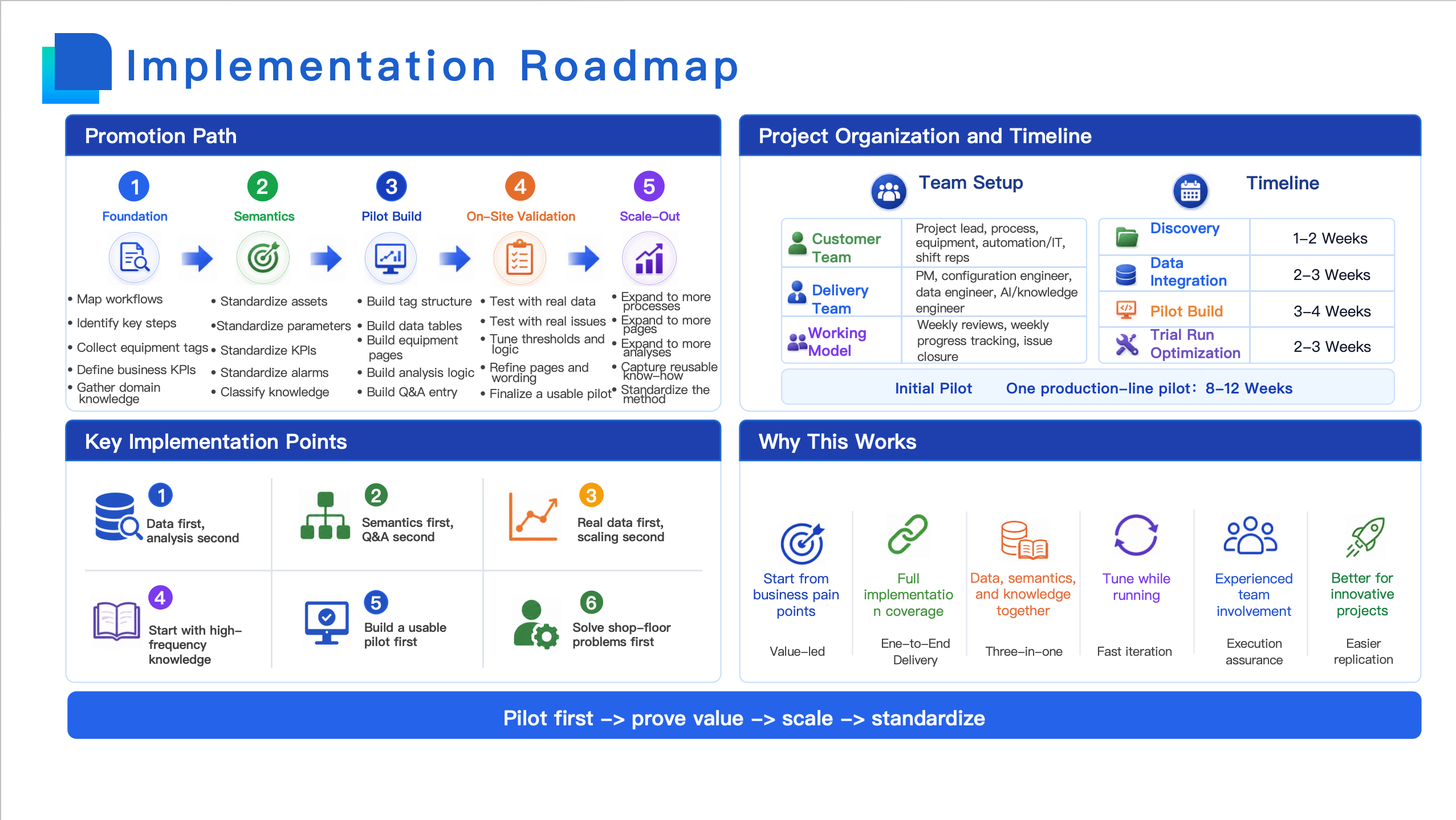
- identify the issue: what fluctuation is affecting results most right now
- form judgment: where the main cause is most likely concentrated
- output recommendation: what to adjust first, what to inspect first, and why
- engineer confirmation: how the site decides to act
- result recovery: whether the indicator actually improved after action
6. Step 4: what acceptance should focus on
For a first pilot, these four dimensions are usually the most useful:
| Acceptance dimension | What to look at |
|---|---|
| Judgment stability | whether the system stays consistent and evidence-backed on similar problems |
| Recommendation usability | whether frontline engineers consider the advice useful and actionable |
| Result improvement | whether output, yield, takt, unit consumption, downtime, or similar indicators improve after action |
| Expert dependency reduction | whether repeated dependence on a small number of experts is reduced |
7. Implementation focus for the first pilot
- define a clear scope around one high-value problem
- connect data access, analytical recommendation, and result verification into one working path
- evaluate the pilot with result-oriented metrics
- expand to more modules, lines, and roles after the first loop is validated
8. A simple readiness check
The first pilot is usually appropriate when these three conditions are met:
- one high-value business problem is already defined
- at least basic object data and core indicators exist
- the team wants to verify whether one scenario can deliver faster judgment and better results
When these three conditions are in place, Prodia can usually start with a small closed loop, prove value, and then expand to more scenarios and broader reuse.