Understand Prodia in 5 Minutes
If this is your first look at Prodia, start with four questions: what it is, what it solves, why it matters now, and where to read next.
1. What Prodia is
Prodia is an AI reasoning and decision system for manufacturing operations.
It organizes equipment data, process knowledge, and frontline experience into judgment and optimization guidance that teams can act on.
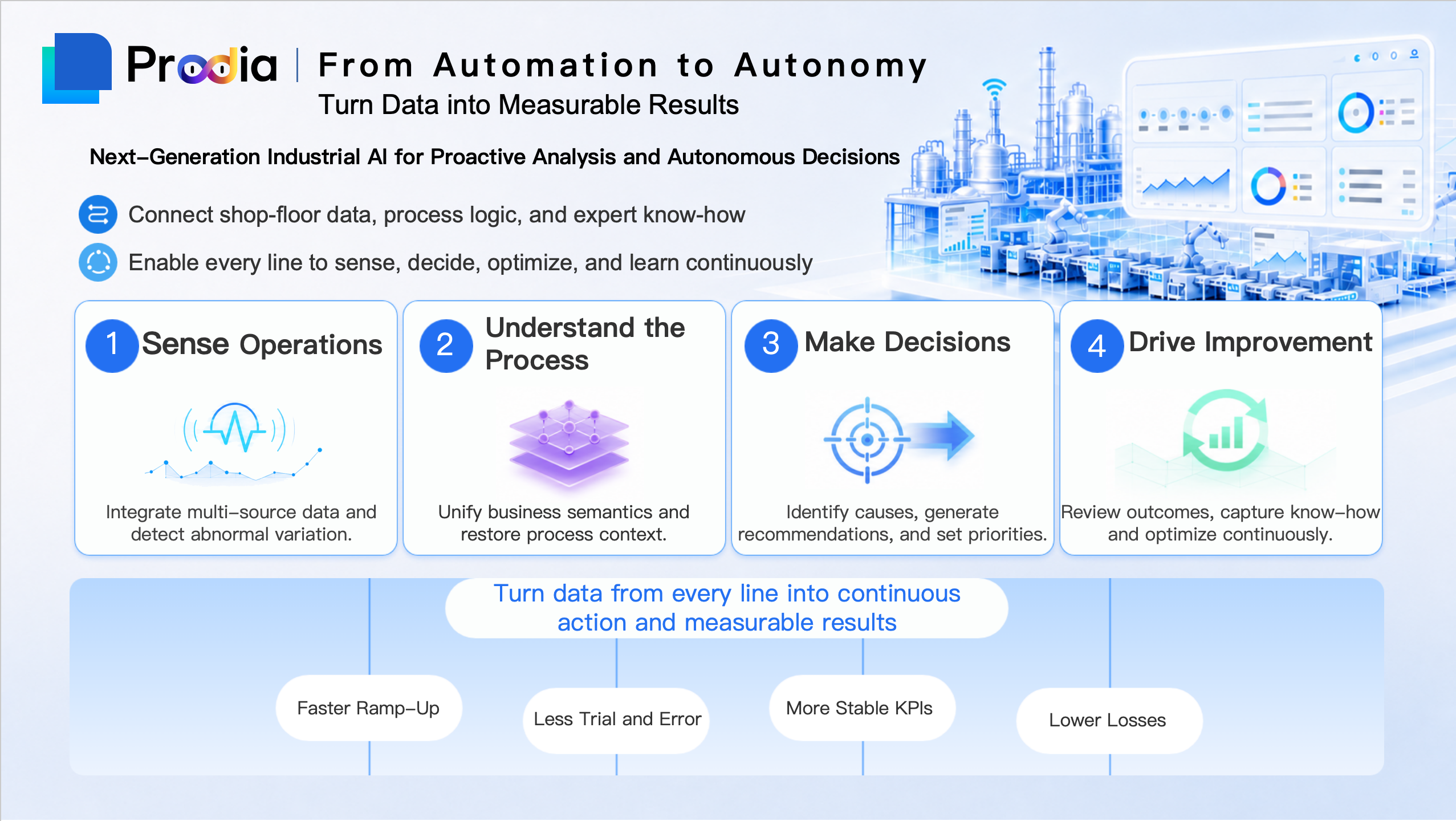
In one line:
Prodia = identify issues + form judgment + recommend actions + recover results
2. How it creates value
Keep these four product characteristics clear from the beginning:
- Data Q&A is the entry point: the core value is forming executable judgment.
- The analysis covers a full chain: the system continues from “what happened” into “why, what next, and how to verify.”
- People and system work together: the system organizes evidence and recommendations, while engineers confirm and execute.
- Outcomes improve the system over time: adoption and results feed back into future recommendations.
3. Why manufacturing teams care about it
| What the site really cares about | Traditional approach | What changes with Prodia |
|---|---|---|
| How fast a new specification can be stabilized | repeated trial tuning and expert-led adjustment | faster process-window matching and adjustment direction |
| Why indicators and equipment condition are getting worse | reports, alarms, and manual experience-based investigation | faster main-cause judgment and action priority |
| How data investment turns into visible results | issues are visible, but action linkage is still slow | judgment connects more directly to stable production, efficiency, consumption, and loss outcomes |
4. Why manufacturing teams care
Manufacturing teams usually evaluate systems against four practical outcomes:
- how quickly a new specification can be stabilized
- how clearly output, takt, yield, and unit consumption fluctuations can be explained
- how early equipment anomalies and risk can be identified
- how directly data investment turns into measurable operating results
5. Where Prodia fits best
Manufacturing plants / end users
- already have some data foundation, but many decisions still rely on human experience
- want faster results in process optimization, operational efficiency optimization, and equipment efficiency optimization
OEMs / service teams
- want to turn commissioning, maintenance, and field troubleshooting into reusable capability
- want to deliver clearer improvement value together with equipment and reporting
Digital transformation teams
- need a clear way to explain why the project matters, where ROI comes from, and where to start
- need a standard story that connects business goals, pilot scenarios, and delivery path
6. What to read next
If you are evaluating the business case
If you are preparing a pilot
If you care more about architecture
7. Where to go after this page
- If you want to know whether it is worth doing: continue with Core Value
- If you want to explain what the product really is: continue with Product Positioning
- If you want to show how it helps the site in practice: continue with Typical Scenarios
- If you want to prepare a first pilot: continue with First Pilot Path